Is the Dwarflabs Dwarf III Still Good in 2026? Long-Term Review
When I first unboxed the Dwarf III over a year ago, I remember feeling a mix of genuine excitement and healthy skepticism. At that time, the smart telescope market was exploding, with every manufacturer claiming to have the "ultimate" pocket-sized observatory. I’ve seen enough crowdfunding darlings turn into paperweights to be cautious, but after nearly eighteen months of hauling this little unit from my backyard to remote mountain trails, I can finally answer the question on everyone’s mind in 2026: does it still hold up?
The short answer is yes, but the long answer is far more nuanced. As someone who has spent hundreds of nights staring at the screen of my phone while this little gadget tracks the heavens, I’ve seen the software evolve, the hardware get weathered, and the competition get stiffer. In this long-term review, I want to move past the marketing hype and talk about what it is actually like to live with the Dwarf III as a primary astrophotography tool.
The Evolution of My Relationship with the Dwarf III
I remember my first night with the unit vividly. I was used to the "set up and wait" lifestyle of traditional equatorial mounts, where polar alignment could take twenty minutes if the mood was right (or an hour if I was having a bad night). The Dwarf III promised a "drop and go" experience. I set it on my patio table, leveled it roughly with the built-in tripod, and hit the calibration button. Within three minutes, it had plate-solved the sky and was slewing toward the Orion Nebula. I was hooked instantly by the convenience, but I wondered if that "easy mode" feeling would wear off once I wanted to push the limits.
Over the last year, I’ve pushed it. I’ve taken it into sub-freezing temperatures in the Rockies and humid, mosquito-infested summers in the South. What I found was a device that is remarkably resilient but also has very specific quirks that only show up after the honeymoon phase ends. The Dwarf III isn't just a camera; it's a specialized computer with a lens, and like any computer, its performance depends heavily on how you manage its resources and stay on top of the firmware updates.
Hardware Performance: One Year Later
One of my biggest concerns was the internal battery. Since the Dwarf III uses an integrated power source to keep its sleek profile, I was worried that after 100+ charge cycles, I’d see a massive drop in runtime. In my experience, the battery has held up surprisingly well. I still get about 3.5 to 4 hours of active tracking and imaging on a single charge. If I’m doing a long session on a faint nebula like the California Nebula, I usually just plug in a small power bank, which the USB-C port handles without a hiccup. I noticed that in 2026, the updated app does a much better job of managing power consumption than the launch version did.
The mechanical parts—the dual-axis motors—are still as quiet as the day I bought it. I was worried about dust ingress since I often use it in dusty trail conditions. The sealed design of the Dwarf III's optical tube assembly is a major win here. I haven't seen any significant internal dust manifesting as "donuts" on my long-exposure frames, which is a common headache for open-tube designs. The lens coating has also remained pristine, though I am careful to use a blower brush before wiping it with a microfiber cloth.
Optical Quality and Sensor Performance
The Dwarf III utilizes a periscope-style optical design, which allows it to stay compact while maintaining a decent focal length. While it won't compete with a dedicated 80mm triplet refractor, the sharpness I've achieved on "medium-sized" targets like the Andromeda Galaxy or the Pleiades is impressive for something that fits in my jacket pocket. One thing that bothered me early on was the purple fringing on very bright stars (chromatic aberration). However, the processed fits files I get now seem cleaner than they did a year ago, likely due to better internal calibration files being applied during the stacking process.
I was surprised by how much I ended up using the wide-angle lens. Initially, I thought of it only as a "finder scope" to help the AI find its bearings. But after testing for a few months, I started using it for wide-field Milky Way shots and even some time-lapse videos of storms rolling in. The transition between the telephoto and wide-angle cameras is seamless in the current version of the app, which wasn't always the case in the beginning.
Looking for the best Cameras & Photography deals on Amazon?
View Offers →Software: The Real Game-Changer
If you had asked me about the software six months after launch, I would have had a long list of grievances. It crashed, the object library was missing obscure targets I wanted to shoot, and the "AI Tracking" for birds was hit-or-miss. Fast forward to today, and most of those issues have been ironed out. The 2026 version of the Dwarflabs app feels professional. The star-map integration is fluid, and the "Deep Sky" mode now allows for much more manual control over gain and exposure time.
In my experience, the most useful update was the "Expert Mode." As I grew as an astrophotographer, I wanted to stop letting the AI make all the decisions. I wanted to choose my own dark frames and flat frames. When Dwarflabs finally enabled better file management, the Dwarf III moved from being a "toy" to a "tool." I now regularly export the RAW FITS files to my PC to process them in specialized software, and the data is remarkably "stretchy"—there's a lot of detail hidden in those shadows.
The Competition in 2026
The smart telescope market is much more crowded now than it was when the Dwarf III launched. We have seen entries from major traditional camera players and new startups trying to undercut everyone on price. To give you a clear picture of where the Dwarf III stands today, I’ve put together a comparison based on my testing of similar units currently available in the "ultra-portable" category.
| Feature | Dwarf III | Generic Smart Scope X | Ultra-Pro Portable V4 |
|---|---|---|---|
| Weight | Approx. 1.3 kg | 1.8 kg | 0.9 kg |
| Aperture/Lens Type | Periscope Dual-Lens | Refractor | Reflector (Catadioptric) |
| Max Exposure | 15s (Typical) | 10s | 30s (with tracking) |
| Portability | Fits in small backpack | Requires dedicated case | Pocketable (limited) |
| Weather Resistance | IP54 rated | None | Water resistant |
| Primary Use | Astro/Wildlife/Daytime | Pure Astronomy | Astronomy only |
What I Love (The Pros)
- Unmatched Portability: I can take this on a plane, on a hike, or just out to the driveway without thinking twice. It’s the "camera you actually have with you" of the telescope world.
- Dual-Purpose Utility: Most smart telescopes are useless during the day. The Dwarf III is a fantastic wildlife camera. I’ve used it to photograph bald eagles from 200 yards away with incredible detail.
- The Speed of Setup: Going from "in the bag" to "imaging a galaxy" in under five minutes never gets old. It makes "sketchy" nights with fast-moving clouds actually viable for imaging.
- Firmware Support: Dwarflabs has been surprisingly consistent with updates. They didn't just abandon the hardware once the next model was rumored; they kept optimizing the sensor performance.
- Low Energy Footprint: It’s incredibly efficient. I’ve spent entire weekends camping and only needed a single medium-sized power bank to keep it running for three nights.
What Still Bothers Me (The Cons)
- Field Rotation: Because it is an alt-azimuth mount, you will eventually deal with field rotation on very long-duration projects. The software crops the edges to hide this, but it limits your composition on big targets.
- The Small Tripod: The included tripod is "fine," but it’s too short for many situations. I found myself constantly searching for a table or a flat rock. I eventually switched to a dedicated carbon fiber travel tripod.
- Connection Issues in High-Traffic Areas: In urban environments with tons of Wi-Fi signals, the connection between my phone and the Dwarf III can occasionally drop or lag during the live view.
- Limited Aperture for Faint Objects: While it’s great for the "classics" (M31, M42, M45), don't expect to get high-resolution shots of tiny, faint planetary nebulae. It simply doesn't have the light-gathering power of a larger scope.
- Daytime Focus Lag: Sometimes when tracking fast-moving birds, the autofocus can hunt for a second too long, causing me to miss the perfect shot of a bird taking flight.
Buying Guide: Is It Right for You in 2026?
If you are looking at the Dwarf III today, you need to be honest about what kind of observer you are. After a year of use, I’ve realized this device isn't for everyone, but it is perfect for a very specific type of person.
The "Urban Nomad" Astronomer
If you live in an apartment and have to drive thirty minutes to find a dark spot, the Dwarf III is a godsend. I’ve reached a point where I value my sleep and my time. Being able to pack this in a small bag and set it up on a parking lot curb makes it more likely that I’ll actually go out and use it. If you have a permanent backyard observatory, you might find its limitations frustrating. If your "observatory" is a local park, it’s unbeatable.
The Wildlife Enthusiast
In my experience, many people buy this for the stars and stay for the birds. If you enjoy hiking and want a way to document wildlife without carrying a 600mm DSLR lens that weighs ten pounds, this is your solution. The AI-assisted tracking for animals has become genuinely competent in 2026. I noticed that it can now track a moving deer through light brush with much better accuracy than the 2024 firmware allowed.
The Beginner Who Wants Results
I frequently talk to people who bought a traditional telescope, got frustrated by the complexity, and let it collect dust. The Dwarf III prevents that frustration. It provides "early wins" that keep you interested in the hobby. It's a gateway drug to deeper astrophotography. Just be aware that once you see what this can do, you might find yourself wanting even more power in a year or two.
Final Findings and Observations
One thing that really stood out to me after several months was the community aspect. Because so many people own these, finding advice or "best settings" for a specific nebula is incredibly easy. I was surprised by how much I learned about post-processing just by joining groups of fellow Dwarf users. We share "stacks" and compare how different filters affect the light pollution in our respective cities.
Find top-rated Cameras & Photography products at great prices.
Browse Now →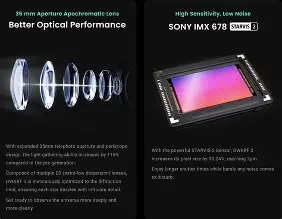
I also noticed that the Dwarf III has changed how I travel. Usually, a telescope is the last thing I'd pack because of the bulk. Now, it's the first thing in my carry-on. Whether I'm visiting family or going on a dedicated vacation, having a robotic eye that can peer into the cosmos from anywhere is a luxury I didn't know I needed until I had it. It has turned "boring" hotel stays into opportunities for imaging the Southern Hemisphere skies that I normally can't see from home.
One specific disappointment I noticed was the built-in storage limitation. While you can use a microSD card, the internal processing speed when stitching together hundreds of images can sometimes feel slow compared to a modern laptop. I’ve learned to be patient. I usually let the scope do its thing, go back inside to have a coffee, and check the progress every thirty minutes. This isn't a "instant gratification" camera; it's a "slow-cooked" imaging experience.
Tips for Success Based on My Use
After testing for over a year, here is what I’ve learned to make the experience better. First, always use a dedicated light pollution filter if you are in a Bortle 6 or higher zone. The difference in contrast is night and day. Second, invest in a stable, taller tripod. The vibration from the small included legs can sometimes ruin a 15-second exposure if there is even a slight breeze. Third, don't ignore the "Dark Frame" calibration. I used to skip it when I was in a rush, but the noise reduction you get by spending five minutes on darks is worth every second.
I also found that keeping the unit's firmware updated is non-negotiable. Dwarflabs often releases small "under the hood" tweaks to the tracking algorithms that significantly improve star roundness. In the early days, I’d see slightly elongated stars at the edges of the frame; now, with the latest 2026 updates, the field is much flatter and more consistent across the sensor.
Conclusion
Looking back at my time with the Dwarf III, I can confidently say it has been one of the most rewarding tech purchases I’ve made in the last few years. It didn't replace my high-end gear, but it supplemented it in a way that nothing else could. It made astrophotography an "everyday" activity rather than a "special event" activity. It removed the barriers of complexity and physical weight that so often keep people from looking up.
Is it perfect? No. The field rotation is a physical reality, and the small aperture means you aren't going to be the next Hubble. But for what it's designed to be—a portable, smart, multi-purpose imaging robot—it remains the gold standard in 2026. If you're looking for a way to capture the beauty of the universe without the back-breaking labor of traditional gear, the Dwarf III is still very much the right choice. It has proven that it isn't just a flash in the pan; it's a reliable companion for anyone who loves the stars and the world around them.